
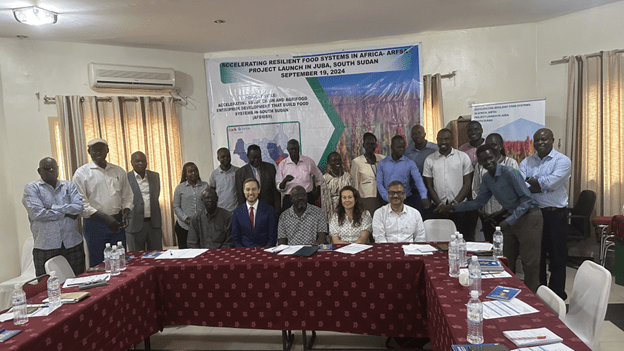
JUBA, South Sudan – 19 September 2024
In a significant stride towards addressing food insecurity in South Sudan, ZOA Dorcas South Sudan, in partnership with the University of Juba, officially launched the accelerating food systems resilience in South Sudan (AFSRiSS) project. This initiative is part of the larger accelerating resilient food systems in Africa (ARFSA) programme, funded by RVO, the Netherlands. This launch marked the beginning of a significant effort to enhance food system resilience in the region.
The gathering saw 24 participants representing key sectors, including academic experts from the University of Juba, the Ministry of Agriculture and Food Security, the Embassy of the Netherlands, international organisations, national civil society groups, and private sector stakeholders focused on food security and livelihoods.
Mr Arend van Vuren, First Secretary for Development Cooperation at the Netherlands Embassy in Juba, praised the collaboration between ZOA Dorcas and the University of Juba. He highlighted that the project’s focus on value chains, agribusiness, and markets is crucial to rural development in South Sudan. He also emphasised the importance of developing a resilient seed system that aligns with local climatic conditions.
The event also featured remarks from Professor Dr Salah Jubarah, Dean of the College of Natural Resources and Environmental Studies at the University of Juba. He highlighted that the ARFSA project builds upon comprehensive food system studies conducted across South Sudan, using food system dialogues and value chains that align with the FARE (food and agricultural resilience for economic development) approach.
Director General of the Ministry of Agriculture and Food Security, Mr Koorg Tud Simon Peter, expressed his enthusiasm and support for the Ministry’s collaboration in addressing the risks associated with accelerating resilient food systems. He stressed the importance of mechanised agriculture to improve food security, adapting crops to climate change, and overcoming environmental challenges to prevent crop failures and ensure food stability.
The project aims to tackle several of the country’s most pressing food security issues, including enhancing resilience in agricultural systems and promoting sustainable seed production. The importance of fostering collaboration across various stakeholders was a recurring theme. Mr Jitendra Panda, Country Director of ZOA Dorcas South Sudan, closed the event by highlighting the necessity of building synergies across projects to strengthen the overall food sector. Panda empasised that it is a collective effort, and working together with other stakeholders is essential for achieving sustainable food systems.
The launch was moderated by Dr Tony Alfred Ngalamu of the University of Juba, and Mr Taban Wodorison, Consortium Coordinator for AFSRiSS, outlined the project’s purpose, activities, and plans for implementation. The project represents a promising opportunity for South Sudan to advance its agricultural resilience in the face of growing environmental and economic challenges.
 ZOA Dorcas South Sudan
Leave a comment